Friday, May 15, 2026
Selling to people who aren't shopping: Why newsletter sponsorships don't convert


If you sell an AI product right now, you've felt the squeeze. Every Google query adjacent to your category has fifteen competitors bidding it. LinkedIn CPMs for tech audiences are at a five-year high. Meta interest targeting against developers and PMs has degraded to the point where you're paying $80 CPMs to reach lookalikes of lookalikes. The "exhaust your intent channels first" playbook is hitting a ceiling, and it's getting more expensive every quarter.
The natural response is to push into non-intent channels: newsletter sponsorships, podcast reads, native placements, developer ad networks. The math kind of works: a $4K newsletter slot in front of 80K engaged subscribers is a low CPM, and the audience is, in theory, your buyer. So you write a check, your read goes live, and... your dashboard shows almost nothing. A few direct visits, some signups attributed to organic that probably came from the placement, and a story you can't really tell finance.
Most people respond to this by either (a) blaming attribution or (b) reframing the spend as "brand." Neither is right. And sometimes, more often than anyone wants to admit, the placement simply didn't work, and no attribution story will rescue it.
The actual problem is that you're paying to interrupt people who weren't shopping, and then offering them nothing that converts that interruption into action today. The window after a podcast read or a newsletter ad is about thirty seconds long. Most marketers cede it.
What sponsorship traffic actually is
Search traffic comes from people who already have a problem they're trying to solve. They've defined it well enough to type it. By the time they click your ad, they're some non-trivial fraction of the way through a buying cycle.
Sponsorship traffic is different. The reader was reading a newsletter about product management or listening to a podcast about engineering culture. You showed up mid-thought. Whatever you sell is, at best, an interesting tangent to what they were doing two seconds ago. Their behavioral signal is zero. They have no problem they're trying to solve right now. They have curiosity about you and forty other things competing for the next minute of their attention.
This is why generic "Sign up free →" CTAs cratered the moment you tried to apply them outside of search. The trial offer is fine in a vacuum, but it competes with the next email in their inbox, the next podcast episode in their queue, and the actual work they're supposed to be doing. You need a reason for the action to happen now.
Tiered scarcity
The mechanic I keep coming back to: a partner-specific landing page with a tiered offer that degrades as supply runs out. Think Kickstarter: the first wave of backers gets the strongest reward, and the offer steps down from there.
It looks like this:
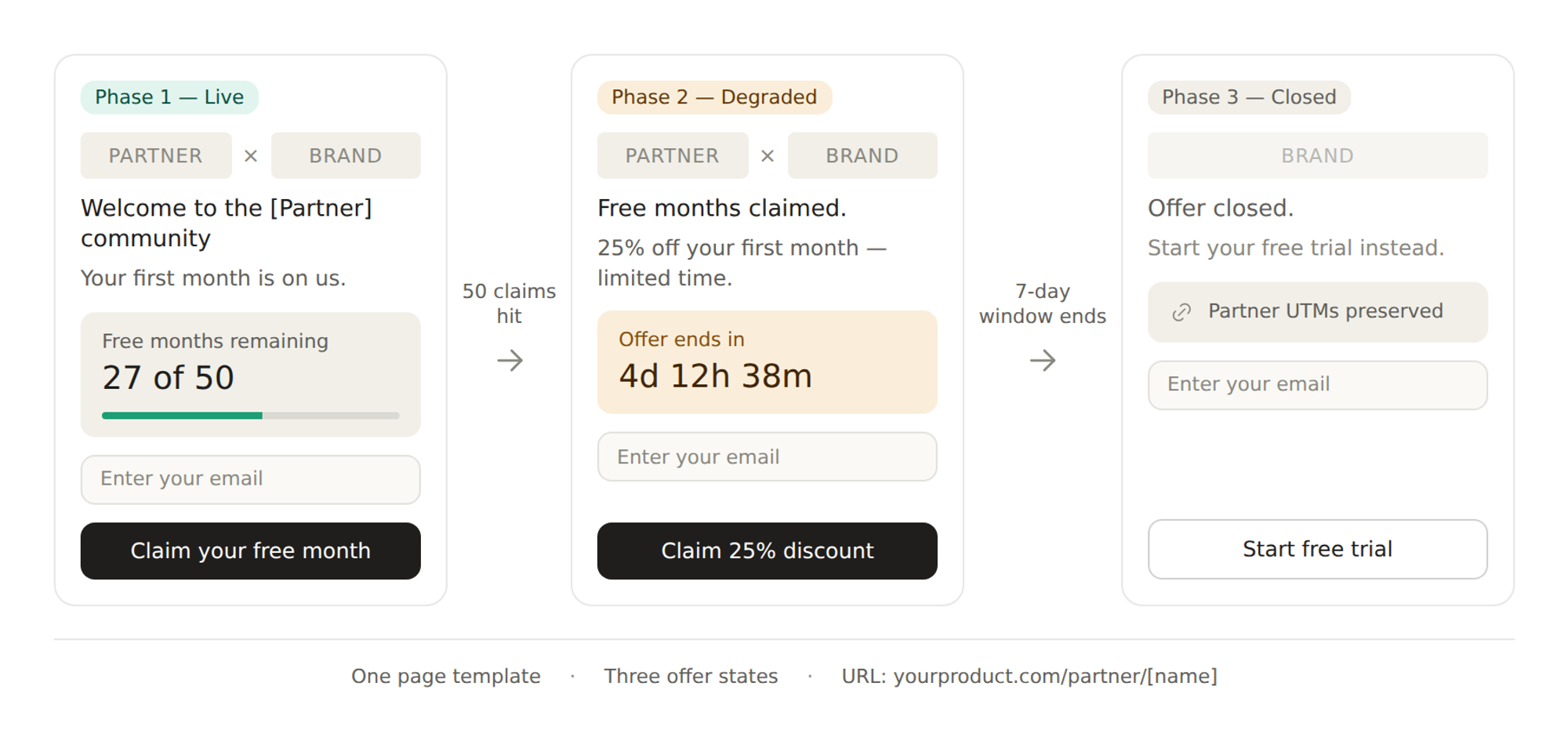
- Each sponsorship gets a dedicated vanity URL, like yourproduct.com/partner/[name], with a co-branded landing page that opens with "Welcome to the [Partner] community."
- The first 50 visitors get the strongest offer you can stomach: typically a free month, free seat, or extended trial.
- Once 50 are claimed, the offer degrades to a percentage discount on the first month, available for a fixed window (usually 7 days).
- After the window closes, the page redirects to standard signup with the partner UTMs preserved.
The newsletter operator or podcast host can write urgency into the read: "Only 50 free months — first come, first served at [URL]." That single line of copy does more work than any creative optimization you could run on the page itself.
Optional extension (h/t Andrew Dertinger): give each of the first 50 a single-use referral invite at the same offer. Turns "I claimed my slot" into "I have one slot to give," a social-capital mechanic that re-extends the placement at zero incremental media cost.
Why this converts the post-read window
A few things are happening at once.
Scarcity makes the action time-bound. The reader's choice isn't "sign up free or not." It's "claim now or lose the slot." That collapses the consideration window from weeks to minutes.
The host is implicitly endorsing the offer. A newsletter operator only mentions "first 50 free" if they're confident the brand picked their audience specifically. That confidence transfers.
You get pseudo-attribution for free. Every signup that touches /partner/[slug] is unambiguously attributable to that placement. UTMs decay in cross-device journeys; vanity URLs typed from a podcast read don't.
The degraded tier captures the long tail. Podcast back-catalogs and newsletter re-reads keep producing traffic for weeks. The percentage-off phase keeps converting that traffic at a known, sustainable cost, instead of letting it bounce.
Live social proof. The "27 of 50 claimed" counter does double duty. It enforces scarcity, but it also ratifies the offer for the late visitor: other people in this exact audience already moved, so it's real.
Whether this works depends on your unit economics
This isn't a universal mechanic. It works when your product has a defined, low-marginal-cost free month: SaaS with clear activation paths, freemium tools, developer products with a metered trial. It doesn't work for enterprise sales cycles, high-touch onboarding, or anything where the marginal cost of a free user is non-trivial.
Before you commit to the structure, run three numbers:
- Max exposure per partner. Free month × cap = your hard ceiling. At a $30/mo plan with a 50-cap, you're risking $1,500 per placement. Easy to absorb. At $300/mo, you're risking $15,000, possibly fine, possibly not.
- Activation rate of the free tier. If 8% of free-month claimers convert to paid after the month ends, your effective CAC is meaningfully different than if 40% convert. Cap sizing should flex against this.
- Anchor risk on the degraded discount. A 50%-off second tier trains the market to wait for promotions. 20–25% rarely does. Pick a number that drives action without restructuring your price perception.
If those three numbers pencil, the mechanic is one of the cleanest ways I've found to put a deadline on a non-intent audience. The reader doesn't need to be shopping for you. They just need to act before someone else does.
If you want to think through how this would map onto your pricing and channel mix (what the right cap is, whether your free tier can absorb the exposure, what the degraded percentage should be), that's the kind of thing we work through with clients every week. Drop us a note below.